






















Hair transplant6 min read
Which instruments are used in a hair transplant?
A hair transplant is delicate microsurgery, and it relies on a set of specialised tools. This article explains the main groups of instruments, from micro-punches for extracting follicles and magnifying loupes to anaesthesia needles, implanter pens and diagnostic cameras, what each one does and why the skill of the team matters as much as the equipment itself.
By messaging us, you agree to our Privacy Policy
Medically reviewed by Ellina V. Goncharova, dermatovenereologist, trichologist, surgeon. Review date: .
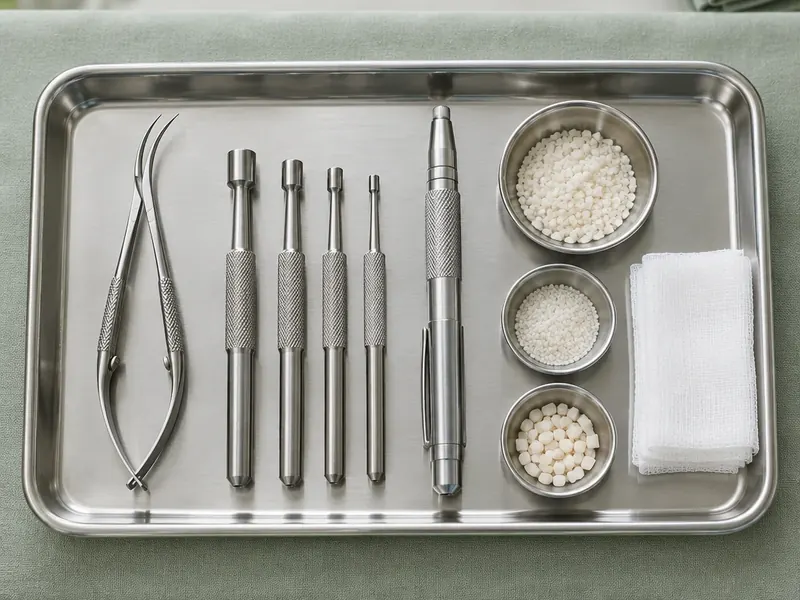
The main points in 30 seconds
- In FUE, follicles are extracted with tiny hollow punches, typically under a millimetre in diameter, manually or with a motorised handpiece.
- Loupes and microscopes let the team extract and sort grafts without damaging the roots.
- The procedure is done under local anaesthesia with fine needles, and the anaesthetic can be topped up during the session.
- Grafts are placed with fine blades and forceps, or with an implanter pen in the DHI technique.
- Sterility and the team's experience matter more than any single instrument, so ask the clinic about both.
Key facts about the procedure
- Stay in clinicSame day
- Final result12–18 months
- AnaesthesiaLocal
- Price
$2,700from $2,200
An overview of the equipment
A hair transplant is a precise microsurgical procedure. It involves magnifying loupes or microscopes, sterile surgical instruments, fine tools for extracting and implanting follicles, needles for local anaesthesia and other equipment. The exact set varies with the technique and with the preferences of the surgeon, but the basic groups of instruments are similar in most clinics.
Price in your country — message us on WhatsApp
WhatsAppKnowing what these tools are for can make the procedure feel less mysterious. Below is an overview of the main groups and the role each plays.
Micro-instruments for extracting follicles
In follicular unit extraction (FUE), individual follicular units are taken from the donor area, usually the back and sides of the head. For this, surgeons use very small hollow punches, typically under a millimetre in diameter. The punch makes a tiny circular incision around the follicular unit, which is then gently lifted out with fine forceps.
More on this topic: Hair Transplant, Hair Transplant for Women, FUE Hair Transplant, FUE & DHI Hair Transplant in Singapore.
Punches can be used manually or attached to a motorised handpiece that rotates or oscillates the tip. Both approaches aim at the same thing: to free the follicle precisely and keep it intact, because a damaged follicle is less likely to grow. The size and type of punch are chosen for the patient's hair and skin.
Instruments for strip harvesting
In follicular unit transplantation (FUT), a narrow strip of skin is removed from the donor area with a scalpel, and the wound is closed with sutures or staples. The strip is then divided into follicular units under magnification, using fine blades on a cutting surface.
Hair transplant abroad: choose a city and clinic
Prices, the clinic and a free online consultation for each city:
Surgical instruments and the sterile field
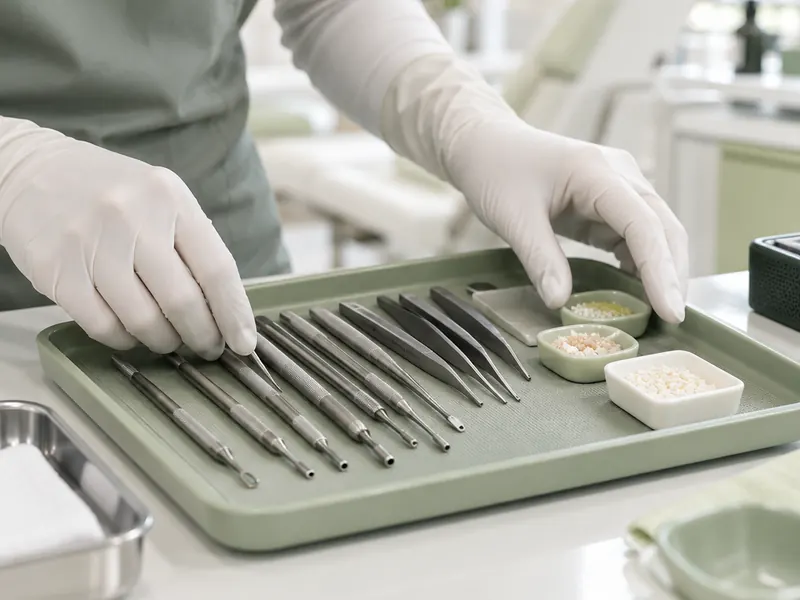
Alongside specialised tools, every transplant relies on standard surgical instruments: scalpels and blades, fine forceps, scissors, needle holders and suture material where needed. Clippers are used to shorten hair in the donor area before extraction.
All instruments that touch the skin are sterile, either single-use or sterilised between patients, and the procedure is carried out under aseptic conditions. Sterility is one of the most important questions to ask any clinic, as it directly affects the risk of infection.
Magnification: loupes and microscopes
Surgeons and their assistants often work with magnifying loupes worn like glasses, and grafts are frequently sorted and trimmed under a stereo microscope. Magnification improves visibility and precision both when follicles are extracted and when they are prepared and implanted.
Careful handling under magnification helps to separate follicular units without cutting through the hair roots and to sort grafts by the number of hairs, so that single hairs can be placed along the hairline and larger units further back.
Anaesthesia: making the procedure comfortable
A hair transplant is usually performed under local anaesthesia. The anaesthetic is injected into the donor and recipient areas with fine needles, and it blocks sensation in those areas for the duration of the procedure. Some clinics use devices that deliver the anaesthetic with less pressure to make the injections more comfortable.
The anaesthetic can be topped up during the session if needed. Before the procedure, tell the doctor about any earlier reactions to anaesthetics and about the medication you take.
Instruments for implanting grafts
Once the grafts are ready, they need to be placed in the recipient area. Depending on the technique, this is done in one of two main ways.
- Recipient sites and forceps. The surgeon creates tiny openings in the skin with fine blades or needles, controlling their angle, direction and depth. The grafts are then placed into these sites with delicate forceps.
- Implanter pens. In the DHI technique, each graft is loaded into a hollow needle inside a pen-shaped implanter and placed directly into the skin. This allows precise control of angle and depth and avoids creating sites separately.
Between extraction and implantation, grafts are kept in a cooled storage solution in small dishes to help them survive outside the body. Keeping this time reasonable is part of good surgical practice.
Get in touch using whichever way suits you
We will answer your questions and find a convenient time for a consultation
By messaging us, you agree to our Privacy Policy
Diagnostic and assessment tools
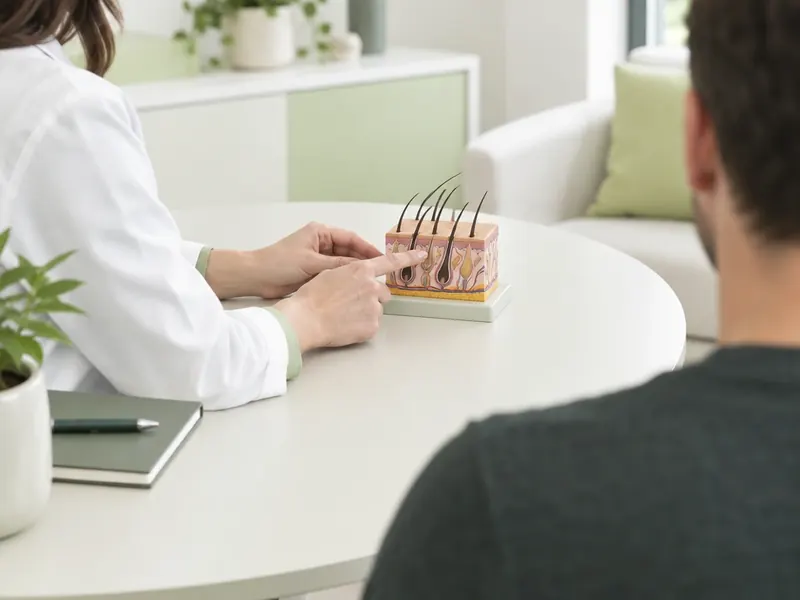
Before and after surgery, doctors may use diagnostic tools such as a dermatoscope or trichoscope, a magnifying camera that shows the scalp and hair roots in detail. It helps to assess hair density, the thickness of hairs and the condition of the donor area, and to plan the number of grafts.
Standardised photographs are usually taken before the procedure and at follow-up visits to track how the hair grows. Some clinics also use robot-assisted systems to help with extraction, but this is one option among several, not a requirement for a good result.
What matters more than the instruments
Instruments are important, but they do not decide the outcome on their own. The experience of the surgeon and the team, careful planning, gentle handling of grafts and good aftercare all play a large role. The choice of technique and tools depends on the pattern of hair loss, the donor area and your goals, and it is made by the surgeon after an examination.
A transplant moves existing hair, but it does not treat the cause of hair loss, so the doctor may also discuss how to protect your native hair. You can read more about the procedure on the hair transplant page.
How recovery usually goes
- 0-10 daysHealing: the crusts come off, the swelling goes down, the area gradually recovers
- 2-4 weeksShedding of the transplanted hairs: a normal stage, only the hairs fall out, the follicles stay in place
- 3-4 monthsGrowth begins: new hairs gradually appear, the result starts to show
- 6-9 monthsVisible density: the hair becomes thicker, the main volume and contour are visible
- 12-18 monthsFinal result: the final density and a natural hairline take shape
Consultation at City Medical Centre
City Medical Centre works with international patients. The first consultation is free and can be held online: send photos of your hair and donor area and ask any question about the techniques and what to expect on the day. The doctor assesses your case and names the cost, which is then fixed in the contract. A personal coordinator stays with you from your first message to the end of recovery, and photos and questions can be sent by Telegram. Find out more on the hair transplant page.
Frequently asked questions
What instrument is used to extract hair follicles in FUE?
Surgeons use very small hollow punches, usually under a millimetre in diameter. The punch makes a tiny circular incision around a follicular unit, which is then lifted out with fine forceps. Punches can be used by hand or with a motorised handpiece.
What is an implanter pen?
It is a pen-shaped tool with a hollow needle used in the DHI technique. A graft is loaded into the needle and placed directly into the skin, which gives precise control of the angle and depth of each hair.
Why do surgeons use loupes and microscopes?
Magnification helps the team see individual follicular units clearly, extract and trim them without damaging the roots and sort grafts by the number of hairs. This supports a natural hairline and helps protect graft quality.
Is the procedure done under general anaesthesia?
Usually not. A hair transplant is normally performed under local anaesthesia injected with fine needles into the donor and recipient areas. The anaesthetic can be topped up during the session, and the approach is agreed with the doctor beforehand.
Do better instruments guarantee a better result?
No. Modern tools help with precision, but the outcome depends largely on the surgeon's experience, careful planning, gentle handling of grafts and aftercare. The technique and instruments are chosen for your case after an examination.
Have a question about your case? Get a free consultation
Message a coordinator on Telegram: we reply right in the chat, and you can send photos and questions there too.
- The first consultation is free, online consultations are available
- The doctor names the cost after the assessment, and it is fixed in the contract
- A personal coordinator guides you from the first message to recovery
Message our coordinator
We reply right in the chat — you can send photos
Message us on TelegramMessage us on WhatsAppBy messaging us, you agree to our Privacy Policy
In other cities
Read also
 Hair transplant
 risks and complications: what is normal and how to lower the risk
What is normal after a hair transplant and what is a complication: swelling, infection, shock loss, poor growth, donor area damage, and how to lower the risk.
 Hair transplant
The history of hair transplantation: from early experiments to modern FUE
How hair transplantation developed: early experiments, Japanese pioneers, Orentreich's donor dominance, follicular units and the arrival of FUE.
 Hair transplant
 methods explained: from outdated techniques to modern FUE and DHI
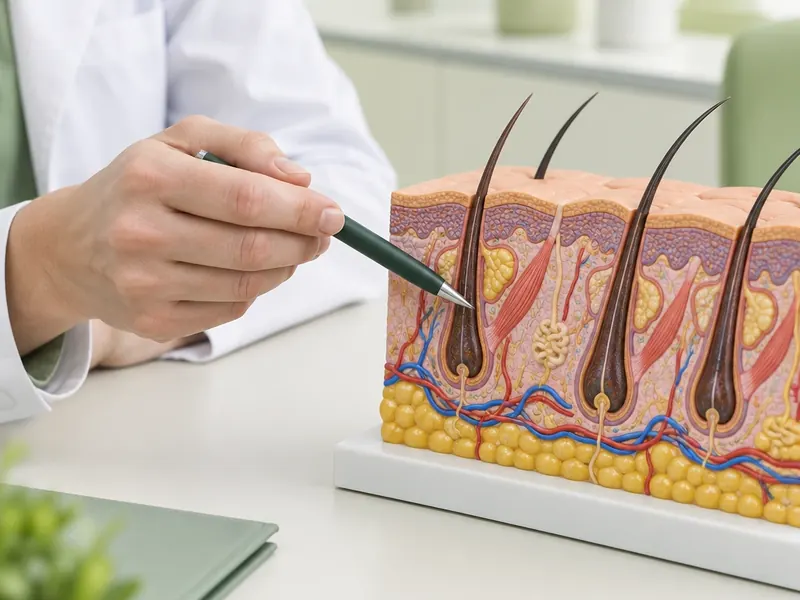
Hair transplant methods explained: why punch grafts, minigrafts and the strip method were replaced, how motorised and manual FUE differ, and where DHI fits.
Medical disclaimer
This article is for general information only and is not medical advice. It does not replace a consultation with a doctor. Every procedure has contraindications and risks. Read more