


























Hair transplant6 min read
The history of hair transplantation: from early experiments to modern FUE
Hair transplantation feels like a modern procedure, but its roots go back almost two centuries. This article follows the main stages of its development, from early experiments and the work of Japanese surgeons to the principle of donor dominance, the discovery of follicular units and the techniques used today, and explains what each step changed for patients.
By messaging us, you agree to our Privacy Policy
Medically reviewed by Ellina V. Goncharova, dermatovenereologist, trichologist, surgeon. Review date: .

The main points in 30 seconds
- The first recorded hair transplant experiments date back to 1822, carried out on animals.
- In 1939 the Japanese surgeon Shoji Okuda described transplanting small round grafts of 1 to 5 mm, mainly for scars and burns.
- In 1959 Norman Orentreich described donor dominance: hair from the back and sides keeps its resistance after being moved.
- Large plugs gave a doll's-hair look, and in the 1980s surgeons moved to smaller grafts and described the follicular unit.
- Follicular unit transplantation appeared in the mid-1990s, and FUE was described in the early 2000s.
Key facts about the procedure
- Stay in clinicSame day
- Final result12–18 months
- AnaesthesiaLocal
- Price
$2,700from $2,200
Why the history of hair transplantation matters
Hair transplantation has a longer history than most people expect. The modern procedure, in which individual follicular units are moved from the back of the head to thinning areas, is the result of well over a century of experiments, mistakes and gradual refinements. Knowing how the technique developed helps explain why today's results tend to look more natural than those of earlier decades, and why surgeons talk so much about donor hair and follicular units.
Price in your country — message us on WhatsApp
WhatsAppBelow is a short overview of the key stages, from early laboratory experiments to the techniques used today.
Early experiments in the 19th century
The first recorded experiments with transplanting hair date back to the early 19th century. Reports from 1822 describe attempts to move hair-bearing skin in animals. These studies were far from a treatment for baldness, but they showed an important principle: skin with hair could be moved to another place and the hair could continue to grow.
More on this topic: Hair Transplant, FUE Hair Transplant, DHI Hair Transplant, Hair Transplant in Atlanta.
For many decades the idea remained a curiosity of experimental surgery. There was no understanding yet of why hair falls out in pattern baldness, and no reliable way to predict whether transplanted hair would survive.
Hair transplant abroad: choose a city and clinic
Prices, the clinic and a free online consultation for each city:
Pioneers in Japan: the first surgical hair restoration
An important chapter was written in Japan in the first half of the 20th century. Japanese doctors, including Masao Sasakawa, Hajime Tamura and Shoji Okuda, described their operations for surgical hair replacement.
Okuda's work is considered especially significant. In 1939 he published a description of transplanting small round grafts of hair-bearing skin, roughly 1 to 5 mm in size, to restore hair in the scalp, eyebrows and moustache. He worked mainly with patients who had lost hair because of scars, burns or congenital conditions. Tamura later described the use of even smaller grafts, an approach that anticipated much later developments.
Because these papers were published in Japanese and appeared around the time of the Second World War, they remained largely unknown in Europe and America for many years.
Norman Orentreich and the principle of donor dominance
The turning point for the treatment of common baldness came in 1959, when the American dermatologist Norman Orentreich published his work on the concept of donor dominance. He showed that hair taken from the back and sides of the head, an area that is usually resistant to androgenetic alopecia, tends to keep its properties after it is moved to a balding area.
In other words, a transplanted follicle behaves according to where it came from, not where it is placed. This principle is still the foundation of hair transplantation today. It also explains why the procedure depends so heavily on the quality and size of the donor area.
Orentreich used round punch grafts of several millimetres, each containing many hairs. He is often called the father of modern hair transplantation.
The era of plugs and the move to smaller grafts
For the next two decades, punch grafts, often called plugs, were the standard technique. They did grow hair, but because each graft contained a tuft of hairs, results could look unnatural, especially along the hairline. The characteristic "doll's hair" appearance of that period is one reason hair transplants once had a poor reputation.
During the 1980s surgeons increasingly worked with smaller mini-grafts and micro-grafts. This allowed softer hairlines and a more gradual transition, although the grafts were still cut without regard to the natural grouping of hairs.
The follicular unit
In the 1980s researchers described the follicular unit: the natural group of one to four hairs that grow together, along with their sebaceous glands and small muscle. This observation changed the way surgeons thought about grafts. If hair naturally grows in these small groups, the most natural result should come from transplanting them intact.
Follicular unit transplantation and the arrival of FUE
In the mid-1990s the surgeons Robert Bernstein and William Rassman formulated the concept of follicular unit transplantation. They proposed moving hair in the same small groups in which it naturally grows, rather than in larger pieces of skin.
At first this was done by removing a strip of skin from the donor area and dividing it into follicular units under magnification, the method now known as FUT.
Building on the same idea, surgeons developed follicular unit extraction, or FUE. In FUE, individual follicular units are taken directly from the donor area with very small punches, usually under a millimetre in diameter, so there is no linear scar. The technique was described in medical literature in the early 2000s and gradually became one of the most widely used methods.
Hair transplantation today
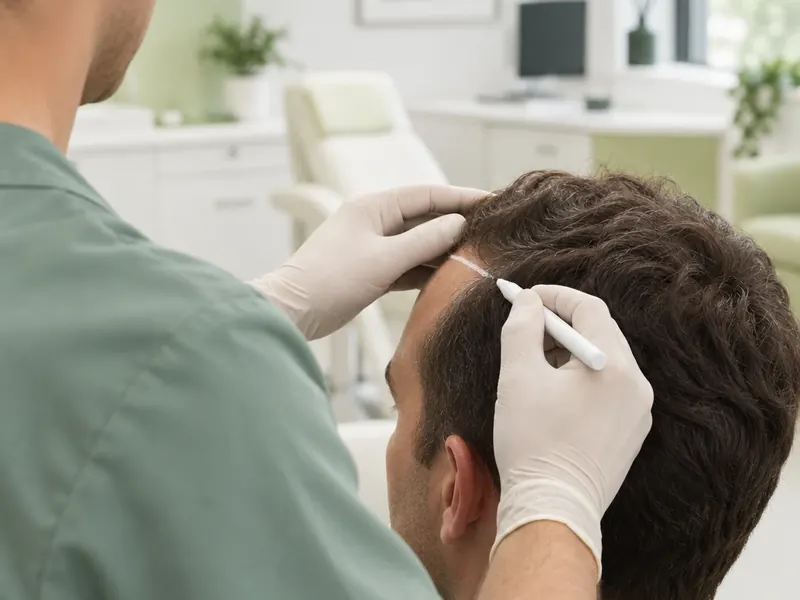
Modern hair restoration combines these ideas with better magnification, finer instruments and more careful planning. Implanter pens, used in the DHI technique, allow grafts to be placed directly into the skin with precise control of angle and depth. Robot-assisted systems can help with extraction in some clinics. Surgeons also pay more attention to hairline design, graft survival outside the body and the long-term management of the donor area.
In current practice, FUE is typically used for androgenetic alopecia, and a combined FUE and DHI approach can be used both for androgenetic alopecia and to add density. The choice always depends on the pattern of hair loss, the donor area and the goals of the patient, and it is made by the surgeon after an examination.
It is also worth remembering what history has taught: a transplant moves existing hair, it does not create new hair and it does not stop the underlying process of hair loss. Many patients need a medical plan to protect their native hair as well. You can read more about the procedure on the hair transplant page.
How recovery usually goes
- 0-10 daysHealing: the crusts come off, the swelling goes down, the area gradually recovers
- 2-4 weeksShedding of the transplanted hairs: a normal stage, only the hairs fall out, the follicles stay in place
- 3-4 monthsGrowth begins: new hairs gradually appear, the result starts to show
- 6-9 monthsVisible density: the hair becomes thicker, the main volume and contour are visible
- 12-18 monthsFinal result: the final density and a natural hairline take shape
Consultation at City Medical Centre
City Medical Centre works with international patients. The first consultation is free and can be held online: send photos of your hair and donor area and ask any question about modern techniques and what they can realistically achieve in your case. The doctor assesses your situation and names the cost, which is then fixed in the contract.
A personal coordinator stays with you from your first message to the end of recovery, and photos and questions can be sent by Telegram. Find out more on the hair transplant page.
Frequently asked questions
Who is considered the father of modern hair transplantation?
The American dermatologist Norman Orentreich is usually given that title. In 1959 he described donor dominance, the principle that hair taken from the back and sides of the head keeps its resistance to androgenetic alopecia after it is transplanted to a balding area.
What is donor dominance?
It is the observation that a transplanted follicle behaves according to the area it came from rather than the area where it is placed. Hair from the resistant donor zone usually continues to grow after transplantation, which is why the donor area is so important.
Why did early hair transplants look unnatural?
Early techniques used large round punch grafts, or plugs, each containing a tuft of hairs. Placed in rows, especially along the hairline, they could create a clumped look. Moving to smaller grafts and then to follicular units made results considerably more natural.
When did FUE appear?
FUE grew out of the follicular unit concept developed in the 1990s and was described in medical literature in the early 2000s. Instead of removing a strip of skin, individual follicular units are extracted with very small punches, leaving no linear scar.
Does a modern hair transplant stop hair loss?
No. A transplant redistributes existing hair from the donor area, but it does not treat the cause of hair loss. Native hair may continue to thin, so the doctor often recommends a plan to protect it as well, decided after an examination.
Have a question about your case? Get a free consultation
Message a coordinator on Telegram: we reply right in the chat, and you can send photos and questions there too.
- The first consultation is free, online consultations are available
- The doctor names the cost after the assessment, and it is fixed in the contract
- A personal coordinator guides you from the first message to recovery
Message our coordinator
We reply right in the chat — you can send photos
Message us on TelegramMessage us on WhatsAppBy messaging us, you agree to our Privacy Policy
In other cities
Read also
 Hair transplant
How to choose a hair transplant clinic and surgeon: what to check before you decide
How to choose a hair transplant clinic and surgeon: qualifications, before-and-after photos, methods, a personal plan, transparent pricing and aftercare.
 Hair transplant
How to grow a beard: from everyday habits to medical options
What decides how your beard grows, which everyday habits may help, what medical options exist and when a beard transplant is worth discussing with a doctor.
 Tummy tuck
How a tummy tuck is performed: step by step from consultation to recovery
What happens during a tummy tuck, step by step: tests and marking, anaesthesia, incision, muscle repair, navel repositioning, drains, hospital stay and first weeks.
Medical disclaimer
This article is for general information only and is not medical advice. It does not replace a consultation with a doctor. Every procedure has contraindications and risks. Read more