


























Osteoarthritis treatment7 min read
PRP or SVF therapy for knee osteoarthritis: how the two methods compare
PRP and SVF are two injection treatments for knee osteoarthritis that use material from your own body: platelet-rich plasma from your blood, and a cell fraction from a small sample of your adipose tissue. This guide compares how each is prepared and given, which stage of arthrosis it usually suits, what to expect over the following months and where the evidence still has limits.
By messaging us, you agree to our Privacy Policy
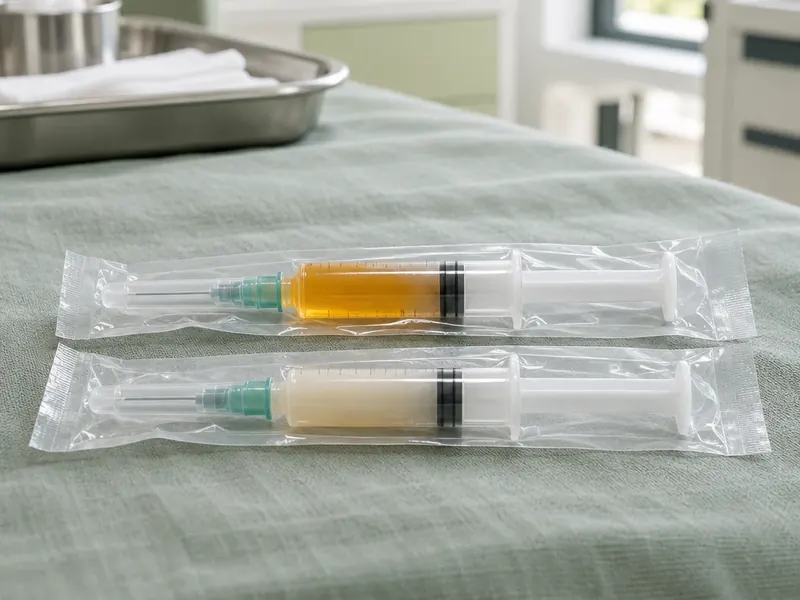
The main points in 30 seconds
- PRP is made from your blood; SVF is a cell fraction from a small sample of your fat, combined with your own plasma.
- PRP is often used for mild knee osteoarthritis, while SVF with PRP is used mainly at early and moderate stages.
- Both are injected under ultrasound in one day, with no crutches and no hospital stay.
- Pain usually eases over the first month, and the full effect develops over around six months; neither method regrows cartilage.
- At an advanced stage injections cannot give a lasting effect, and joint replacement may be the more realistic option.
PRP or SVF: the short answer
Both treatments are injections into the knee under ultrasound guidance, and both use only your own tissue, so no donor or synthetic material is involved. The difference lies in what is injected and how it is obtained.
- PRP (platelet-rich plasma) is separated from a small amount of your blood. It is often used for mild osteoarthritis and can be given as a course of injections.
- SVF (stromal vascular fraction) is a mix of cells isolated from a small sample of your adipose tissue and combined with your own plasma. It is used mainly at early and moderate stages, when a stronger or longer-lasting effect is the goal.
Which method suits you depends above all on the stage of arthrosis. That is decided by a doctor after an examination and a review of your X-rays or MRI.
What PRP and SVF actually are
PRP: concentrated platelets from your blood
Blood is taken from a vein, as for an ordinary blood test, and spun in a centrifuge. The layer of plasma rich in platelets is collected. Platelets carry growth factors, proteins involved in healing, and the aim of the injection is to calm inflammation in the joint and create better conditions for tissue repair.
SVF: a cell fraction from your adipose tissue
Under local anaesthetic, a small portion of fat is taken through a puncture on the abdomen or inner thigh; no stitches are needed. The sample is processed in a centrifuge to isolate the stromal vascular fraction, a mixture of cells that take part in tissue repair. It is then mixed with platelet-rich plasma and injected into the knee.
SVF is sometimes described as stem cell therapy, but it is not a cell product grown in a laboratory. It is prepared from your own tissue, and the whole procedure is done in one day.
PRP vs SVF at a glance
Source material
- PRP
- Your own blood
- SVF with PRP
- Your own adipose tissue and plasma from your blood
How it is obtained
- PRP
- Blood sample from a vein
- SVF with PRP
- Blood sample plus a small fat sample through a puncture under local anaesthetic
Usual stage
- PRP
- Mild osteoarthritis
- SVF with PRP
- Early and moderate osteoarthritis
Main aim
- PRP
- Calm inflammation and pain, support tissue repair
- SVF with PRP
- Reduce pain and friction in the joint, help slow cartilage wear
Number of injections
- PRP
- Can be a course; set by the doctor
- SVF with PRP
- Set by the doctor after reviewing your scans
How long the effect lasts
- PRP
- Often several months to about a year
- SVF with PRP
- Can last longer; varies from person to person
How the procedure goes
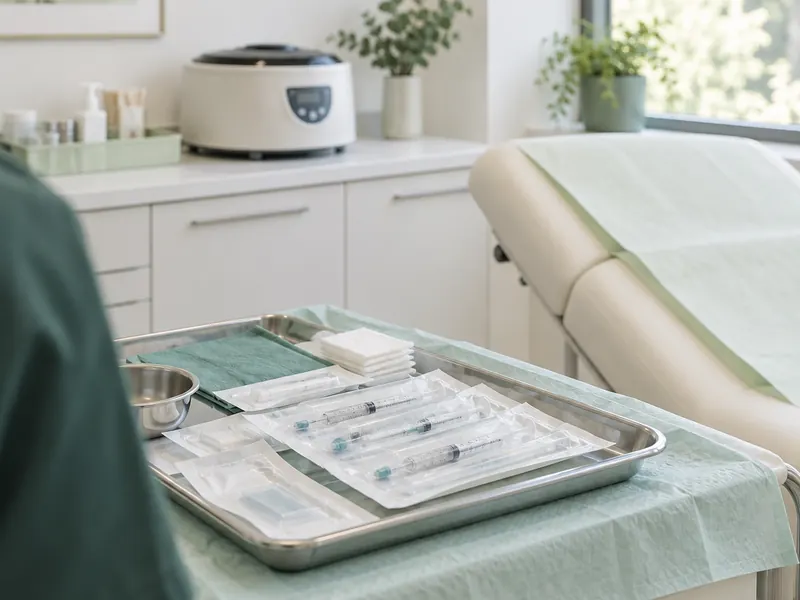
- Consultation and scan review: the doctor examines the knee and reviews your X-rays, MRI or ultrasound. If you already have scans, you can send them in advance.
- Blood sample: a small amount of blood is taken from a vein to prepare the plasma. The doctor tells you beforehand which tests are needed.
- Adipose tissue sample, for SVF only: a small portion of fat is taken through a puncture under local anaesthetic.
- Processing: the material is spun in a centrifuge; for SVF the cell fraction is isolated and mixed with the plasma.
- Injection: the prepared material is injected into the knee under ultrasound guidance, which helps place it precisely.
- Follow-up: there are no crutches and no hospital stay. The doctor stays in touch and follows how the knee responds.
PRP alone takes less time, because no fat sample is needed. SVF with PRP is still completed within one day.
Get in touch using whichever way suits you
We will answer your questions and find a convenient time for a consultation
By messaging us, you agree to our Privacy Policy
Which method suits which stage of knee arthrosis
Doctors describe knee osteoarthritis, or gonarthrosis, in stages, usually based on X-ray findings: how much the joint space has narrowed, whether there are bony spurs and how the joint surfaces have changed. The stage matters more than anything else when choosing between PRP and SVF.
- Early stage: occasional pain after walking or on stairs, stiffness after rest. PRP is often considered first; SVF may be discussed if a longer effect is the goal.
- Moderate stage: more frequent pain, crunching, reduced movement and narrowing visible on X-ray. SVF combined with PRP is more often chosen at this point.
- Advanced stage: the joint space has almost disappeared and the joint is deformed. A lasting effect from injections cannot be expected, and the doctor will tell you honestly if joint replacement is the more realistic option.
The earlier treatment starts, the better the chance of a lasting effect. More about the options is on our osteoarthritis treatment page.
What to expect, and what the evidence says
Changes come gradually rather than straight after the injection. Follow-up visits are usually planned at about one, three and six months:
- in the first week the knee may ache a little more, which is an expected reaction;
- many patients notice the first changes after two to three weeks;
- over the first month pain usually eases;
- over about three months mobility and activity improve;
- the full effect develops over around six months.
After PRP the effect often lasts from several months to about a year; after SVF it can last longer. Duration depends on the stage, body weight, activity level and individual factors, so no one can promise a fixed result.
It is important to be realistic about the research. Orthopaedic organisations point to a growing number of studies supporting PRP for mild to moderate knee osteoarthritis, but results differ between patients and between preparation methods. Reviews of SVF describe improvements in pain and function, yet they rest on a small number of dissimilar studies, and cell products still need to be standardised. Research is ongoing.
Neither method regrows lost cartilage. The aim is to reduce pain, improve function and support the joint you still have.
Contraindications and recovery
Who should not have the procedure
- cancer;
- pregnancy and breastfeeding;
- blood clotting disorders;
- acute infections, including infection in or near the joint;
- a flare-up of a serious chronic illness, or serious heart, kidney or liver disease.
Fever, a cold or flu, or skin inflammation over the knee are temporary reasons to postpone the injection. The doctor checks all of this at the consultation.
Recovery
Most people go home the same day and return to normal daily activity within a day or two. The puncture sites are covered with small dressings, and after SVF the area where fat was taken may be tender or bruised for a few days. As with any injection, temporary pain, swelling or bruising are possible, and infection is rare.
The doctor gives individual advice on load and exercise for the first weeks. In the longer term, keeping a healthy weight and regular joint-friendly activity such as swimming, cycling or Nordic walking help the result last longer.

Consultation at City Medical Centre
City Medical Centre works with international patients. The first consultation is free and can be held online: send your X-rays, MRI or medical reports, and a doctor will assess the stage of knee osteoarthritis and tell you whether PRP, SVF or neither is appropriate. The cost is named after this assessment and fixed in the contract.
A personal coordinator stays with you from your first message to the end of recovery, and scans and questions can be sent by Telegram. Find out more on the osteoarthritis treatment page.
Sources
- AAOS OrthoInfo — Platelet-Rich Plasma (PRP)
- Versus Arthritis — Osteoarthritis of the knee
- Boada-Pladellorens A. et al. Stromal vascular fraction therapy for knee osteoarthritis: a systematic review. Ther Adv Musculoskelet Dis, 2022 (PMC)
- PubMed / NCBI — Core Recommendations for Osteoarthritis Care: Systematic Review of Clinical Practice Guidelines (2023)
- PubMed / NCBI — Managing osteoarthritis (Aust Prescr, 2015)
Medical disclaimer. This article is for general information only and is not medical advice. It does not replace a consultation with a doctor. Every procedure has contraindications and risks. Read more · How we prepare and review medical content
Frequently asked questions
Which is better for knee osteoarthritis, PRP or SVF?
Neither is better for everyone. PRP is often used for mild osteoarthritis, while SVF combined with PRP is used mainly at early and moderate stages when a stronger or longer-lasting effect is the goal. The choice depends on the stage, which the doctor assesses from your X-rays or MRI.
Can PRP or SVF regrow knee cartilage?
No. Neither treatment can be relied on to regrow lost cartilage. The aim is to reduce pain and inflammation, improve function and support the tissues of the joint. Research is ongoing, and the result differs from person to person.
How soon will I feel a difference?
Many patients notice the first changes after two to three weeks. Pain usually eases over the first month, mobility improves over about three months and the full effect develops over around six months. The knee may ache a little more during the first week.
Is the procedure painful?
Blood is taken from a vein as for a routine test, and the fat sample for SVF is taken through a puncture under local anaesthetic. The injection itself is brief. Mild aching in the knee or tenderness at the puncture site for a few days is expected.
Can PRP or SVF help at an advanced stage?
At the most advanced stage, when the joint space has almost disappeared, a lasting effect from injections cannot be expected. In that case the doctor will review your scans and tell you honestly whether joint replacement is the more realistic option.
Have a question about your case? Get a free consultation
Message a coordinator on Telegram: we reply right in the chat, and you can send photos and questions there too.
- The first consultation is free, online consultations are available
- The doctor names the cost after the assessment, and it is fixed in the contract
- A personal coordinator guides you from the first message to recovery
Message our coordinator
We reply right in the chat — you can send photos
Message us on TelegramMessage us on WhatsAppBy messaging us, you agree to our Privacy Policy
Read also
 Osteoarthritis treatment
Shoulder osteoarthritis: symptoms, stages and treatment options
Shoulder osteoarthritis explained: why the cartilage wears, typical symptoms and stages, which scans are needed, and how exercise, PRP and SVF can help.
 Osteoarthritis treatment
Hip osteoarthritis (coxarthrosis): how it is treated without surgery
Can hip osteoarthritis (coxarthrosis) be treated without surgery? Causes, stages, scans, exercise, PRP and SVF injections, and when replacement is needed.
 Hair transplant
 for a receding hairline: how a natural hairline is designed and what results to expect
How a receding hairline is restored with a hair transplant: who it suits, how a natural hairline is designed, FUE or DHI, grafts, recovery and results.