


























Osteoarthritis treatment6 min read
Knee osteoarthritis: stages, symptoms and treatment without surgery
Knee osteoarthritis is one of the most common reasons for knee pain in adults, and it rarely appears overnight. It develops in stages, from occasional stiffness to constant pain and a deformed joint. This guide explains why it happens, how each stage feels, how the diagnosis is confirmed and which non-surgical treatments can help at each stage, as well as when injections are no longer enough.
By messaging us, you agree to our Privacy Policy

The main points in 30 seconds
- Knee osteoarthritis develops in stages, from mild stiffness to pain at rest and deformity.
- Age, excess weight, past injuries and leg alignment raise the risk.
- An X-ray taken standing is the basic scan; MRI adds detail on cartilage and menisci.
- Exercise and weight control come first; PRP and SVF suit early and moderate stages.
- When cartilage is largely gone, injections rarely help and replacement is discussed.
Can knee osteoarthritis be treated without surgery?
In many cases, yes, especially at the early and moderate stages. Non-surgical treatment cannot rebuild a worn joint, but it can ease pain, keep the knee moving and slow down further wear of the cartilage.
The earlier treatment starts, the more options there are. At an advanced stage, when the cartilage has largely worn away, injections and exercise may bring only limited relief, and joint replacement is often discussed. That is why it makes sense not to wait until the pain becomes constant.
Why knee osteoarthritis develops
Osteoarthritis, also called arthrosis, is a condition in which the cartilage covering the ends of the bones gradually thins. Cartilage acts as a smooth shock absorber. As it wears, the bones begin to rub, small bony outgrowths form and the joint lining can become irritated.
There is rarely a single cause. The risk usually rises with:
- age: most people with knee osteoarthritis are over 45;
- excess body weight, which increases the load on the knees with every step;
- previous injuries, such as a torn meniscus or ligament damage;
- heavy physical work or sport with repeated kneeling, squatting or impact;
- leg alignment, such as bow legs or knock knees;
- family history and being female.
Some of these factors cannot be changed, but weight, activity and muscle strength can, and they have a real effect on how the condition progresses.
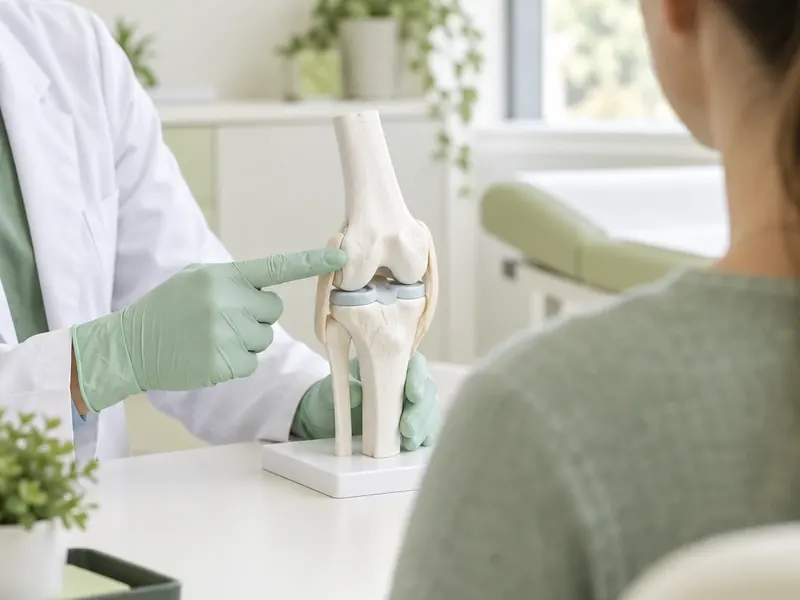
Stages of knee osteoarthritis and their symptoms
Doctors often describe knee osteoarthritis in stages based on symptoms and X-ray findings. The borders between stages are not sharp, and symptoms do not always match the picture on the scan.
Early
- How it usually feels
- Stiffness after rest, mild ache after long walks or stairs
- What scans show
- Minimal changes, small bony outgrowths may appear
Moderate
- How it usually feels
- More frequent pain, crunching, stiffness in the morning, occasional swelling
- What scans show
- Visible narrowing of the joint space
Advanced
- How it usually feels
- Pain at rest and at night, limited bending, a change in the shape of the leg
- What scans show
- Marked narrowing, bone rubbing on bone, deformity
Common signs at any stage include pain that gets worse with activity, stiffness after sitting, a grating or crackling feeling, and weakness or a sense that the knee may give way. Flare-ups with swelling and warmth can come and go.
How the diagnosis is confirmed
The diagnosis usually starts with a conversation and an examination. The doctor asks about your pain, how long it has lasted and what makes it worse, then checks movement, swelling, tenderness and the alignment of the leg.
Scans help to confirm the stage and rule out other causes:
- X-ray, ideally taken while standing, shows the joint space, bony outgrowths and deformity;
- MRI shows the cartilage, menisci, ligaments and bone in more detail;
- ultrasound can show fluid in the joint and inflammation of the soft tissues;
- blood tests are sometimes used to rule out inflammatory arthritis.
If you already have recent scans, a specialist can often review them remotely before deciding what else is needed.
Non-surgical options by stage: exercise, PRP, SVF
The foundation at every stage
Health guidelines agree that exercise and weight control come first. Strengthening the thigh muscles takes pressure off the knee, and even moderate weight loss can noticeably reduce pain. Low-impact activity such as cycling, swimming and walking on flat ground usually helps. Supportive footwear, a walking aid during flare-ups and physiotherapy are also useful. Painkillers and anti-inflammatory medicines can ease symptoms for a time, but they should be chosen by a doctor.
PRP: platelet-rich plasma
PRP is prepared from a small amount of your own blood and injected into the knee. It is often considered at the early and moderate stages to calm inflammation and ease pain. Research results are encouraging for mild to moderate knee osteoarthritis, but they vary, and PRP does not grow new cartilage.
SVF: cell therapy from your own adipose tissue
A small sample of fat is taken under local anaesthetic, the stromal vascular fraction is isolated and injected into the joint together with plasma. It is used mainly at early and moderate stages when a stronger effect is sought. Evidence is still developing, so a realistic discussion with the doctor matters.
At City Medical Centre both methods are performed under ultrasound guidance, without a hospital stay; details are on our osteoarthritis treatment page.
When injections are not enough
Injections work best while there is still cartilage to protect. They are unlikely to give a lasting effect when:
- the joint space has almost disappeared and bone rubs on bone;
- the leg is visibly deformed;
- pain is severe at rest and at night despite treatment;
- the knee no longer bends or straightens enough for daily life.
In such cases a surgeon may discuss knee replacement. An honest assessment of the stage is the best way to avoid spending time and money on treatment that cannot help, and to choose the right moment for surgery if it is needed.

Getting a personal plan at City Medical Centre
City Medical Centre works with international patients. The first consultation and the review of your scans are free and can be done online: send your X-rays, MRI or reports and describe your symptoms. The doctor assesses the stage, tells you whether PRP or SVF makes sense in your case and, if they do, names the cost, which is then fixed in the contract.
A personal coordinator guides you from the first message through the procedure and follow-up, and answers questions by Telegram. Find out more on the osteoarthritis treatment page.
Sources
- NHS — Osteoarthritis
- AAOS OrthoInfo — Arthritis of the knee
- Versus Arthritis — Osteoarthritis of the knee
- PubMed / NCBI — Core Recommendations for Osteoarthritis Care: Systematic Review of Clinical Practice Guidelines (2023)
- PubMed / NCBI — Managing osteoarthritis (Aust Prescr, 2015)
Medical disclaimer. This article is for general information only and is not medical advice. It does not replace a consultation with a doctor. Every procedure has contraindications and risks. Read more · How we prepare and review medical content
Frequently asked questions
What are the stages of knee osteoarthritis?
Doctors usually describe an early stage with stiffness and mild pain after effort, a moderate stage with more frequent pain, crunching and visible narrowing of the joint space on X-ray, and an advanced stage with pain at rest, limited movement and deformity of the joint.
Can knee osteoarthritis be treated without surgery?
At the early and moderate stages it often can. Exercise, weight control and physiotherapy are the foundation, and injections such as PRP or SVF may be added. Treatment does not rebuild a worn joint, but it can ease pain and help keep the knee moving.
Do PRP injections help knee arthrosis?
For many people with mild to moderate knee osteoarthritis, PRP eases pain and improves function for a period of months. Results vary between patients and studies, and PRP does not grow new cartilage. Whether it suits you is decided by the doctor after reviewing your scans.
Which scans are needed for knee osteoarthritis?
An X-ray, ideally taken standing, is the basic scan for assessing the stage. An MRI adds detail about cartilage, menisci and ligaments, and ultrasound can show fluid and inflammation. The doctor decides which scans are needed after the examination.
When is knee replacement unavoidable?
Replacement is usually discussed when the cartilage has largely worn away, the joint is deformed and pain at rest or at night persists despite treatment. The decision is made by an orthopaedic surgeon together with you, based on symptoms, scans and daily limitations.
Have a question about your case? Get a free consultation
Message a coordinator on Telegram: we reply right in the chat, and you can send photos and questions there too.
- The first consultation is free, online consultations are available
- The doctor names the cost after the assessment, and it is fixed in the contract
- A personal coordinator guides you from the first message to recovery
Message our coordinator
We reply right in the chat — you can send photos
Message us on TelegramMessage us on WhatsAppBy messaging us, you agree to our Privacy Policy
Read also
 Arthritis treatment
Knee arthritis: causes, types and the treatment options available today
Why knee arthritis develops, the main types, how doctors diagnose it, treatment from exercise to PRP and SVF injections, and when to seek urgent care.
 Osteoarthritis treatment
Living with knee or hip osteoarthritis: exercise, weight and daily habits
How to live well with knee or hip osteoarthritis: safe exercise, weight, footwear and insoles, daily adjustments, and how habits support PRP or SVF treatment.
 Liposuction
Liposculpture vs Liposuction: Body Contouring Explained
Liposculpture vs liposuction: what the terms mean, how each approach works, how results and recovery compare, and who each one suits. A clear guide to body contouring.