






















Hair transplant6 min read
FUE hair transplant step by step: what happens on the day and during recovery
FUE is one of the most widely used ways to restore hair with your own follicles. This guide follows the procedure in the order it actually happens: preparation, the stages on the day of surgery, the first days afterwards and the months of regrowth, so you know what to expect at each point and which questions to raise with your surgeon.
By messaging us, you agree to our Privacy Policy
Medically reviewed by Ellina V. Goncharova, dermatovenereologist, trichologist, surgeon. Review date: .
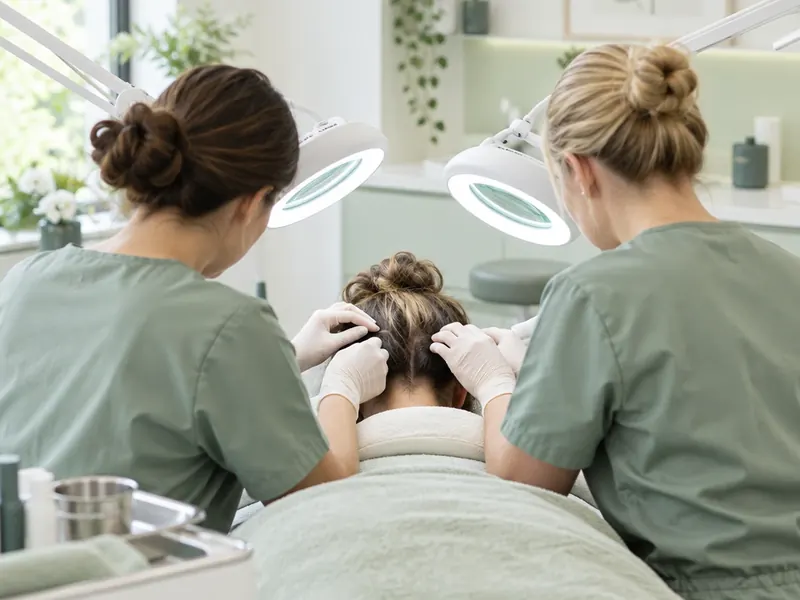
The main points in 30 seconds
- FUE moves grafts one by one from the back and sides of the head, leaving no linear scar, only tiny dot-like marks.
- Smoking and alcohol are usually stopped two to three weeks before surgery; the session itself lasts four to eight hours under local anaesthesia.
- Crusts usually come away within 7 to 14 days, and many people return to office work after two to three days.
- Most transplanted hairs fall out at weeks 3 to 4; new hair appears at months 3 to 4 and the result is judged at 12 to 15 months.
- Avoid saunas and pools for one to two months and protect your scalp from strong sun.
Key facts about the procedure
- Stay in clinicSame day
- Final result12–18 months
- AnaesthesiaLocal
- Price
$2,700from $2,200
What FUE is and why the donor area matters
FUE (Follicular Unit Extraction) is a way of moving your own hair from where it grows well to where it has thinned. Instead of cutting out a strip of skin, the surgeon removes grafts one by one. A graft is a natural group of one to four hair follicles, exactly as they grow in the scalp.
Price in your country — message us on WhatsApp
WhatsAppThe grafts are taken from the donor area at the back and sides of the head. In most people with androgenetic alopecia, hair in this zone is genetically resistant to dihydrotestosterone (DHT), the hormone behind pattern hair loss, so it tends to keep growing after it has been moved. This is why the quality and size of the donor area largely decide what a transplant can achieve.
Each graft is released with a punch, a micro-instrument usually between 0.6 and 1.0 mm in diameter. There is no stitched incision, so FUE does not leave a linear scar: the donor area is left with tiny dot-like marks that are normally hidden by the surrounding hair.
Who FUE suits and when it is postponed
FUE is used for men and women with androgenetic alopecia, to correct or lower the hairline, to add density to thinning areas and, in some cases, to restore hair in scars after injuries or burns. What it cannot do is create new donor hair: when hair loss affects the whole scalp, including the back and sides, there is nothing to transplant, and the surgeon will explain other options.
More on this topic: Hair Transplant, FUE Hair Transplant, DHI Hair Transplant, FUE & DHI Hair Transplant in Singapore.
Some conditions rule out surgery or require treatment first:
- serious uncontrolled chronic illness, such as decompensated diabetes or haemophilia, and active cancer;
- blood clotting disorders, which need to be assessed by a doctor beforehand;
- a flare-up of scalp conditions such as psoriasis or dermatitis, which is usually treated before the transplant.
A transplant also does not stop the underlying hair loss. Native hair around the grafts may continue to thin, so many surgeons discuss supportive treatment alongside the operation.
Hair transplant abroad: choose a city and clinic
Prices, the clinic and a free online consultation for each city:
Before the day of surgery
Good preparation makes the procedure smoother and lowers the risk of complications. It usually includes:
- Consultation and diagnosis. The doctor examines the thinning area and the donor area, assesses hair density and the stage of hair loss, and may use trichoscopy to look at the follicles more closely.
- Blood tests. A standard panel typically covers a full blood count, biochemistry, clotting, and screening for HIV, hepatitis and syphilis.
- Lifestyle changes. Smoking and alcohol are usually stopped two to three weeks before surgery, as they impair blood flow and may affect graft survival. Blood-thinning medicines are paused only if your doctor agrees.
- Scalp preparation. You may be asked to wash your hair with a particular shampoo for a few days beforehand.
The day of the procedure, stage by stage
An FUE session usually lasts four to eight hours, depending on how many grafts are moved. You are awake throughout and can rest, read or watch a film during the quieter phases.
Stage 1: planning and shaving
The surgeon confirms the plan with you, draws the new hairline and marks the areas to be treated. The hair in the donor area is then trimmed short so each follicular unit can be seen and extracted cleanly.
Stage 2: local anaesthesia
The donor and recipient areas are numbed with local anaesthetic. The injections sting briefly; after that, most patients feel pressure and movement rather than pain. If sensation returns during the session, the team can top up the anaesthetic.
Stage 3: extracting the grafts
Using the micro-punch, the surgeon removes grafts one at a time from the donor area, spreading them out so the zone does not look patchy. This stage calls for great precision, because a damaged follicle is less likely to grow.
Stage 4: preparing the grafts
Assistants sort the extracted grafts by the number of hairs, clean them and keep them in a special storage solution so they stay viable until they are implanted.
Stage 5: creating the channels
In the recipient area, the surgeon makes tiny channels at the angle and direction in which your natural hair grows. This step largely determines how natural the result will look, especially along the hairline.
Stage 6: placing the grafts
The grafts are placed into the channels, usually with single-hair grafts at the front and larger groups further back. Along with the channel work, this is the stage that shapes the future density and natural appearance.
After the last graft: the first days
At the end of the session, the donor area may be covered with a light dressing, and you receive written instructions on sleeping position, washing, medication and activity. Most patients go home or to their hotel the same day.
In the first days some swelling and redness around the transplanted area are common. Small crusts form around the grafts and usually come away on their own within 7 to 14 days, provided you follow the washing technique the doctor shows you. Many people return to office work after two to three days, while heavy physical work and sport wait longer.

Recovery and growth over the following months
- Weeks 3 to 4: most transplanted hairs fall out. This is the expected shock loss; the follicles stay in the skin and enter a resting phase.
- Months 3 to 4: new hairs begin to appear, at first fine and light.
- Months 6 to 12: the hair gradually gains normal thickness and colour.
- Months 12 to 15: the final result can usually be assessed.
If the thinning area is large and the donor supply limited, a second session may be discussed, typically 10 to 12 months after the first.
Practical tips for a smooth recovery
- Follow your surgeon's aftercare instructions closely, especially in the first two weeks.
- Protect the scalp from strong sun and avoid sunbeds for the first months.
- Use only the washing and care products your doctor recommends.
- Avoid saunas, steam rooms and swimming pools for one to two months.
- Be patient: hair growth is slow, and judging the result too early often causes needless worry.

How recovery usually goes
- 0-10 daysHealing: the crusts come off, the swelling goes down, the area gradually recovers
- 2-4 weeksShedding of the transplanted hairs: a normal stage, only the hairs fall out, the follicles stay in place
- 3-4 monthsGrowth begins: new hairs gradually appear, the result starts to show
- 6-9 monthsVisible density: the hair becomes thicker, the main volume and contour are visible
- 12-18 monthsFinal result: the final density and a natural hairline take shape
Planning FUE at City Medical Centre
City Medical Centre works with international patients. The first consultation is free and can take place online: you can send photos of your scalp and your questions on Telegram, and the doctor will assess your donor area and suggest a plan. The price is given after this assessment and fixed in the contract, and a personal coordinator stays with you from the first message to recovery. You can read more about the procedure on our hair transplant page.
Frequently asked questions
How long does the result of an FUE transplant last?
Grafts are taken from the donor area, where hair is usually resistant to the hormone behind pattern hair loss, so transplanted hair tends to keep growing for many years. Native hair around it may still thin over time, which is why your doctor may suggest supportive treatment.
Does FUE hurt?
The procedure is done under local anaesthesia, so most patients feel only the brief sting of the injections and then pressure rather than pain. Mild soreness and tightness in the first days are common and are usually managed with the painkillers your doctor prescribes.
When can I go back to work after FUE?
Many patients return to office work and everyday life after two to three days if they follow the aftercare instructions. Heavy physical work, sport and activities that make you sweat heavily usually need to wait longer, and your surgeon will tell you when.
Can FUE cover a large bald area?
It depends on the size of your donor supply. At the consultation the doctor estimates how many grafts can be taken safely and whether the desired density is realistic. For extensive thinning, two sessions around 10 to 12 months apart are sometimes planned.
Why is the donor area shaved before FUE?
Short hair lets the surgeon see each follicular unit and its direction of growth, which makes extraction more precise and reduces damage to the follicles. The shaved area normally grows back within a few weeks and hides the tiny extraction marks.
Have a question about your case? Get a free consultation
Message a coordinator on Telegram: we reply right in the chat, and you can send photos and questions there too.
- The first consultation is free, online consultations are available
- The doctor names the cost after the assessment, and it is fixed in the contract
- A personal coordinator guides you from the first message to recovery
Message our coordinator
We reply right in the chat — you can send photos
Message us on TelegramMessage us on WhatsAppBy messaging us, you agree to our Privacy Policy
In other cities
Read also
 Hair transplant
FUT (strip) vs FUE hair transplant: scars, grafts and recovery compared
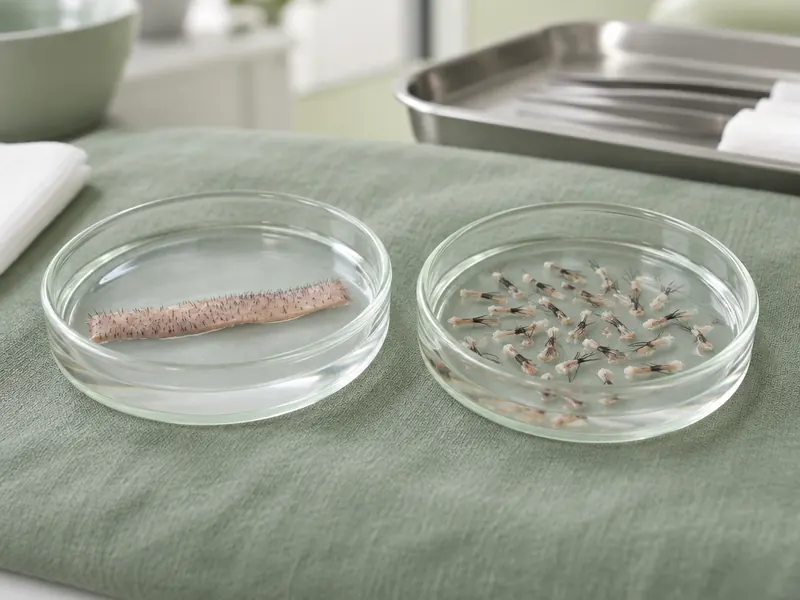
FUT (strip) or FUE hair transplant? How each method takes grafts, what scars they leave, how recovery differs and who each one suits best.
 Hair transplant
Hair care with age: how to keep ageing hair healthy
How hair changes with age and how to care for it: gentle washing, nutrition, careful brushing, less heat and when thinning needs a doctor.
 Facelift
Full (circular) facelift: what it corrects, who it suits and what recovery involves
What a full circular facelift corrects, who it suits and who it does not, how the operation and the first weeks with a face bandage go, and how long results last.
Medical disclaimer
This article is for general information only and is not medical advice. It does not replace a consultation with a doctor. Every procedure has contraindications and risks. Read more